News
A 19% tariff line — and what it actually buys Pakistani exporters
Pakistan sits below India, Bangladesh and Vietnam on the new US tariff schedule. Whether that gap converts into orders depends on something tariffs cannot fix.
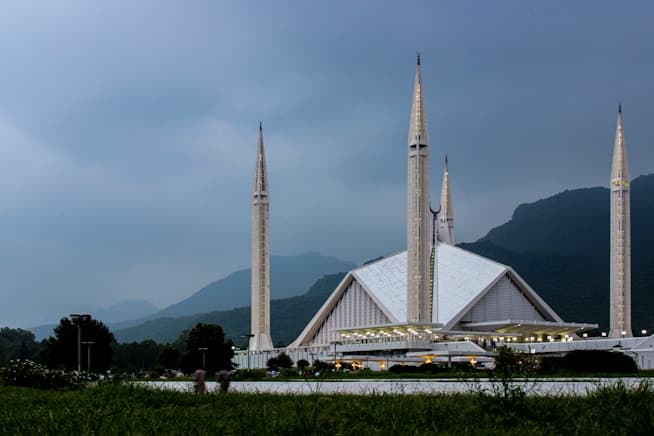
Faisal Mosque, Islamabad, lit at dusk below the Margalla Hills
Pakistani goods enter the United States under a 19 percent reciprocal tariff, revised down from the 29 percent rate first announced when Washington invoked the International Emergency Economic Powers Act. The reduction followed a bilateral trade agreement finalised in Washington, and Islamabad described the outcome as balanced and forward-looking.
Read against the rest of the schedule, the number is more interesting than it looks in isolation. Pakistan's 19 percent sits below India at 25 percent, Bangladesh and Vietnam at 20 percent, and Iraq at 35 percent — level with Indonesia. For the first time in a long while, a Pakistani manufacturer quoting a US buyer is not the expensive line on the sheet.
- 19%
- Pakistan
- 20%
- Bangladesh · Vietnam
- 25%
- India
A margin is not an order
A five- or six-point tariff advantage is real money on a container of home textiles or gloves. It is also, on its own, inert. Tariff differentials only move volume when a buyer somewhere decides to re-source — and re-sourcing is not a pricing decision, it is a qualification decision. Before a US importer moves a programme out of one origin and into another, someone has to find candidate factories, confirm they exist, confirm they hold the certifications the category requires, sample them, audit them, and get the whole thing through a compliance desk. That process runs in weeks, sometimes months, and it starts with search.
This is the part of the trade story that policy cannot legislate. Pakistan has spent two decades negotiating access it then struggles to use at speed, because the country's supply base is largely invisible to the people doing the searching. A buyer who wants 40 shirt manufacturers in Faisalabad with a specific certification and a demonstrated export history has no authoritative place to get that list. They have a trade fair they may have missed, a consulate that may or may not answer, and a set of global marketplaces where a Pakistani factory looks exactly like an unverified trading company in another country.
Tariff advantage has a shelf life. The schedule that favours you this year is renegotiated the next. What compounds is being easy to find, easy to verify, and easy to buy from.
The uncertainty exporters actually described
When Profit surveyed exporters in late February, the reported mood was not celebration but uncertainty. The rate itself has moved twice inside a year, a temporary 10 percent measure under Section 122 of the Trade Act of 1974 has run alongside it, and separate US action citing forced-labour concerns has touched dozens of trading partners including Pakistan. Order books get planned against a rate that may not survive the planning cycle.
The rational response to a volatile tariff environment is not to bet the year on one line of the schedule. It is to widen the number of buyers who can reach you, in enough markets that any single schedule matters less. That is a distribution problem, and distribution for a manufacturer means being present, verified and legible wherever sourcing decisions get made.
What this window is for
- Get the documentary house in order — registration, tax status, certifications, capacity, and export history in one place a buyer can be pointed at.
- Treat the tariff gap as a reason to be contacted, not a reason to wait. Buyers re-sourcing out of higher-tariff origins are searching now.
- Assume any advantage is temporary and build the buyer relationships that outlast it.
Al-Ukaz exists for the middle of that list. A verified national record of who makes what in Pakistan does not change a tariff line. It changes how many buyers can act on one.
- Tariffs
- United States
- Exports
Sources
- Dawn — Pakistani goods face reduced 19pc US tariff as Trump hits dozens of countries with steep duties
- Profit (Pakistan Today) — Pakistan exporters face uncertainty after US tariff shifts
- Arab News — Pakistan says progress made in reciprocal trade talks with US
Figures are as reported at the dates given and are provisional where the underlying series is. Where published estimates differ, the range is stated in the text.
Get new pieces as they publish
Reporting and analysis on Pakistan's export economy, emailed when we publish. No membership pitch, and you can leave whenever you want.
Prefer a reader? RSS feed
Be the supplier a buyer can actually find
Al-Ukaz is building Pakistan's verified record of who makes what — company by company, document by document. Registration for manufacturers is open now.
Join the founding cohort