Insight
Sialkot makes the world's instruments. The world cannot name its makers.
One district supplies most of the planet's manual surgical instruments and most of its hand-stitched footballs — almost entirely without attribution.
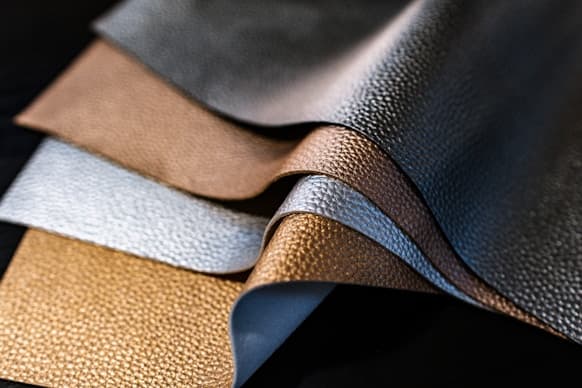
Finished leather hides fanned out in tan, grey and black
There is no other district in Pakistan quite like Sialkot, and few anywhere. It produces an estimated 99 percent of the country's surgical instruments, and industry and provincial sources put its share of the world's manual surgical instruments at somewhere between 75 and 80 percent. Roughly 80 percent of that output goes to the United States, Germany, the United Kingdom, France, Italy, the UAE, Japan and the Netherlands.
The sports goods cluster next door is equally lopsided. Sialkot supplies something over 70 percent of world demand for hand-stitched inflatable footballs — on the order of 40 million balls a year — across roughly 2,400 companies employing more than 200,000 people directly. Published export figures for the sports segment range from about $450 million to $700 million depending on the source and the year, inside a district export total commonly cited at around $3 billion.
Treat all of those numbers as indicative. They come from provincial data, association estimates and trade press at different dates, and they do not fully agree with each other. The order of magnitude is not in dispute, and the order of magnitude is the point.
- 75–80%
- of world manual surgical instruments
- ~70%
- of hand-stitched footballs
- 200,000+
- direct jobs in sports goods
A century of anonymity
The cluster is over a hundred years old. It began, by the standard telling, with British doctors in colonial Punjab having instruments repaired by local metalworkers, who then learned to make them. That origin — repair work, done to someone else's specification, under someone else's name — has proved remarkably durable as a business model.
A forceps made in Sialkot is finished, packed and marked in Germany. A ball stitched in Sialkot carries a European or American mark. The value added in the district is real; the value captured is a fraction of it, because the customer relationship, the brand and the regulatory registration all sit downstream. Contract manufacturing at this scale is not a failure — it is an achievement — but it is a ceiling, and the cluster has been sitting under it for decades.
The instrument on the tray in a Munich operating theatre was almost certainly made in Sialkot. Nothing on it says so, and no buyer had to know.
What moves the ceiling
Two things, historically, have let clusters like this move up: standards and identity. Standards — CE marking, FDA registration, ISO 13485, credible ethical-labour audit — take a supplier from subcontractor to qualified vendor. Identity is what makes the qualification worth anything: a buyer has to be able to find you, by name, and confirm the standards independently.
Sialkot has done more on the first than it is given credit for. The district's response to the 1990s child-labour crisis in football stitching — moving stitching into monitored centres — was one of the more serious industry-led compliance programmes in the region, and it is a large part of why global brands still source there.
The second has barely been attempted. Search for surgical instrument manufacturers in Sialkot and you will find directory spam, a handful of self-published company sites of varying vintage, and no authoritative list of who is real, what they are certified for, and what they can actually make. A hospital group in Nairobi or a distributor in Lyon that wanted to buy direct has no reliable way to start.
The unglamorous version of industrial policy
Nobody will move Sialkot up the value chain with a slogan. What changes the economics is prosaic: a verified, current, public record of the district's manufacturers — legal entity, site, certifications with issuers and expiry, product capability, capacity, export history — that a foreign buyer can search without an intermediary and trust without a visit.
That is the whole of the Al-Ukaz thesis, and Sialkot is its clearest test case. A cluster that already makes most of the world's supply of two product categories does not need to become better at manufacturing. It needs to become findable under its own name.
- Sialkot
- Precision
- Discovery
Sources
- Government of Punjab — Sialkot key industries
- Pakistan Bureau of Statistics — External trade statistics (monthly and annual)
- Trade Development Authority of Pakistan — Sports goods and surgical instruments sector profiles
Figures are as reported at the dates given and are provisional where the underlying series is. Where published estimates differ, the range is stated in the text.
Get new pieces as they publish
Reporting and analysis on Pakistan's export economy, emailed when we publish. No membership pitch, and you can leave whenever you want.
Prefer a reader? RSS feed
Be the supplier a buyer can actually find
Al-Ukaz is building Pakistan's verified record of who makes what — company by company, document by document. Registration for manufacturers is open now.
Join the founding cohort