Insight
Pakistan's export target has a credit problem — and it isn't at the top
SMEs are more than 90% of Pakistan's businesses and take 6–7% of private-sector credit. Banks are not being unkind; they are pricing the absence of information.
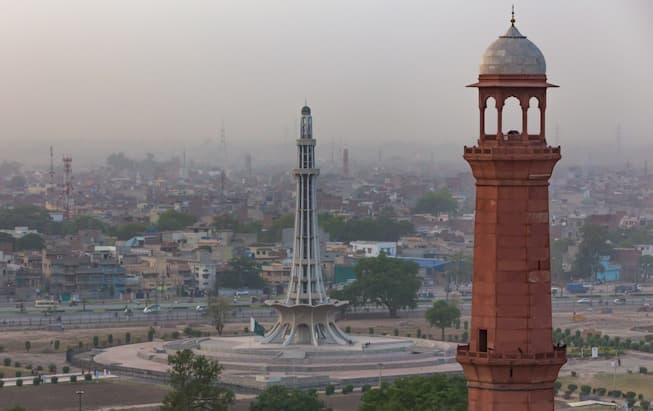
Minar-e-Pakistan and the Badshahi Mosque minaret above Lahore
Two numbers, put next to each other, explain most of why Pakistan's export base has stayed narrow. Small and medium enterprises account for more than 90 percent of the country's businesses and an estimated 40 percent of GDP. They receive roughly 6 to 7 percent of private-sector credit.
- 90%+
- of businesses are SMEs
- ~40%
- of GDP
- 6–7%
- of private-sector credit
The state has noticed. The Prime Minister has directed authorities to make financing more accessible to SMEs explicitly as an export measure; the Finance Minister announced a dedicated task force to expand bank lending to the segment. An SME Finance Task Force now sits under the State Bank, with the Pakistan Banks' Association, SMEDA, the chambers, and the Ministry of Finance at the table. Subsidised export financing has been widened, with Rs88 billion allocated under the Export Finance Scheme.
All of that is necessary. None of it, by itself, closes the gap — because the gap is not primarily a shortage of allocated rupees.
What a bank is actually declining
When a mid-sized unit in Sialkot or Faisalabad is turned down for working capital against a confirmed export order, the credit committee is rarely making a judgment about the factory. It is making a judgment about what it can verify. Is the company registered and current? Is it tax-compliant? Does it hold the certifications its category requires, and are they in date? Has it shipped before, to whom, and did it get paid? Is the order real?
In most cases the honest answer from the lender's side is: we cannot cheaply find out. So the loan gets priced for that ignorance, or collateralised against land, or declined. The firm concludes that banks do not lend to people like them. Both parties are behaving rationally inside a market with no shared, trustworthy record of who these firms are.
Information asymmetry is not a soft problem. It is the interest rate, expressed as a refusal.
The same file solves two problems
The striking thing about the evidence a lender wants is how closely it matches the evidence an international buyer wants. A German importer qualifying a new supplier asks for legal existence, ownership, capacity, certifications, audit history and references. A bank underwriting the same firm asks for legal existence, tax status, capacity, certifications and shipment history. The overlap is nearly total.
Today a Pakistani manufacturer assembles that pack from scratch, in PDF, every time — once for each buyer, once for each bank, once for each chamber form. It ages badly, it is unverifiable at the other end, and it does not accumulate into anything. The firm's reputation stays trapped in the heads of the people who already know it.
A verified national supplier record inverts that. The documentation is collected once, checked against the issuing authority, and kept current — and it then serves the buyer, the lender, the insurer and the trade body from the same source. The firm stops paying the verification cost repeatedly and starts compounding it.
Where this can go wrong
- A registry that accepts self-declared claims is worse than none — it teaches lenders to distrust the whole category.
- Verification has to be renewable. A certification confirmed once in 2024 is a liability in 2027.
- Coverage matters more than polish. A record of 300 firms nobody has heard of is not yet market infrastructure.
That is the discipline Al-Ukaz is being built to. Company-level review, documents checked rather than uploaded and forgotten, and a published profile a buyer or a bank can be pointed at without a covering email. The credit gap will not close because someone announced a facility. It closes when the firms on the other side of it become knowable.
- SME
- Finance
- Growth
Sources
- Arab News — Pakistan PM orders easier SME financing to boost exports, growth
- Dawn — Subsidised Rs88bn export financing
- State Bank of Pakistan — Export Finance Scheme
Figures are as reported at the dates given and are provisional where the underlying series is. Where published estimates differ, the range is stated in the text.
Get new pieces as they publish
Reporting and analysis on Pakistan's export economy, emailed when we publish. No membership pitch, and you can leave whenever you want.
Prefer a reader? RSS feed
Be the supplier a buyer can actually find
Al-Ukaz is building Pakistan's verified record of who makes what — company by company, document by document. Registration for manufacturers is open now.
Join the founding cohort