Sector
Handicrafts & Artisan Goods
Living craft traditions — Multan blue pottery, Sindhi ajrak, hand-knotted carpets — made by named workshops, at volumes a retail buyer can actually place.
- Multan
- largest handicraft manufacturing city
- 6+
- distinct regional craft traditions
- Hand-made
- at a price that supports real handwork
Why buyers source here
Genuinely hand-made, at a workable price
Hand skills here are priced so that real handwork remains commercially viable — which is increasingly rare, and exactly what the premium retail segment is looking for.
Traditions with a provenance story
Multan blue pottery, Sindhi ajrak block printing, ralli quilting, Balochi mirror embroidery and hand-knotted carpets are living crafts with documented histories, not reproductions.
Volumes a buyer can actually place
Workshop-scale production suits the order sizes museum shops, design houses and direct-to-consumer brands work with — rather than the container minimums factory sourcing demands.
Provenance that carries a margin
A named workshop, a place and a documented process are what let a retailer tell the story and price accordingly. That attribution is the value here.
Every other sector on this site competes on capacity, cost or compliance. This one competes on something scarcer: work that is genuinely made by hand, by people who learned the craft from the people who did it before them, at a price that still makes handwork commercially viable.
That combination is getting rare. Most markets have either lost the skills or priced them out of reach of anything but luxury. Pakistan has kept both — Multan has the largest concentration of handicraft manufacture in the country, and craft traditions across Sindh, Punjab, Balochistan and Kashmir remain in continuous production rather than revival.
What is actually being made
Multan blue pottery, with Persian-influenced motifs and luminous glazes, is the best-known ceramic tradition. In Sindh, ajrak block printing in deep indigo and madder, and ralli quilting in geometric patchwork, carry centuries of documented symbolism. Balochistan contributes mirror embroidery; Kashmir hand-knotted carpets and shawls; Chiniot carved and inlaid furniture. Truck art — Pakistan's most internationally recognised visual idiom — has moved from vehicles onto homeware and accessories.
Why order sizes work in your favour
Craft production is workshop-scale, and for the right buyer that is a feature. Museum shops, design-led retailers, hotel and interiors specifiers and direct-to-consumer brands rarely want container minimums; they want a few hundred pieces of something with a story, repeatable next season. That is precisely what this supply base is built to do.
In this category the maker's name is not marketing. It is the reason the piece is worth what it is worth.
The one thing to insist on
Ask who made it. Craft goods from Pakistan have historically entered international supply chains as unbranded consignments, with intermediaries capturing most of the value and the workshop's identity stripped away in transit. That is bad for the artisan, and it is bad for you: without provenance you cannot tell the story that justifies the price, and you cannot be sure of what you are buying.
A verified record of the workshop — its legal existence, its location, its craft, its capacity and who it has supplied — restores that attribution. It is the single most valuable thing this platform can do for this sector, and the reason we treat handicrafts as a first-class category rather than a footnote.
One caveat we would rather state than hide: we are not quoting an export figure for this sector, because handicraft output is scattered across informal units and captured inconsistently in the trade statistics. The totals in circulation vary too widely to publish as fact.
What Pakistan makes
- Ceramics
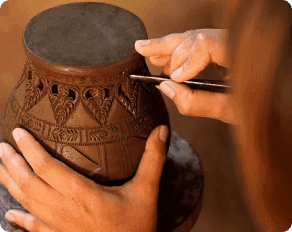
- Multan blue pottery, with Persian-influenced motifs and glazes made the same way for centuries.
- Textile crafts
- Sindhi ajrak block printing, ralli quilts, Balochi mirror embroidery, phulkari and hand-knotted carpets.
- Wood, brass & metal
- Carved furniture, inlay work, brassware and copper — much of it from Chiniot.
- Leather & footwear crafts
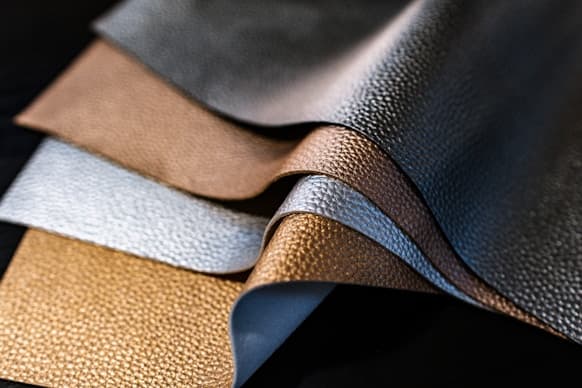
- Khussa, camel-skin lamps and hand-tooled goods.
- Truck art
- Pakistan's most internationally recognised craft idiom, now applied across homeware and accessories.
Where it is made
- Multan
- Blue pottery and the largest concentration of handicraft manufacture in the country.
- Sindh — Hala, Bhit Shah, Tharparkar
- Ajrak, ralli, lacquerware and mirror work.
- Chiniot
- Carved and inlaid wood furniture, a trade several generations deep.
- Balochistan & Kashmir
- Mirror embroidery, shawls and hand-knotted carpets.
Standards this sector works to
What to ask for when you qualify a supplier in this category, and what an established exporter will already hold. Al-Ukaz checks these against the issuing body rather than taking an upload on trust.
Artisan traceability
Who made it, where, and by what process. In this category that is the product, not the paperwork.
Fair-trade certification
Carries a genuine premium in the buyer segment that wants these goods.
Materials & safety compliance
Dye, lead and finish limits for ceramics and textiles sold into the EU and US.
Geographical indication
Where a craft holds a protected name, it is worth asking for — it is the strongest guarantee of origin available.
Sourcing handicrafts & artisan goods from Pakistan?
Tell us what you are looking for — category, volumes, the certifications you need — and we will point you at verified manufacturers who can serve it. Al-Ukaz operates under the endorsement of the Ministry of Commerce, Government of Pakistan.
Talk to us about sourcingManufacture in this sector?
Get on the record buyers are being pointed at. Registration for Pakistani manufacturers is open now.
Join the founding cohortSources
- The Express Tribune — Handicrafts: Pakistan's most neglected export potential
- Trade Development Authority of Pakistan
Figures are as reported at the dates given and are provisional where the underlying series is. Where published estimates differ, the range is stated in the text.